Showing posts with label consumerism and its discontents. Show all posts

February 05, 2014

Everything I like is from 2008

marc by marc jacobs finch charm
(Although this was originally sold in 2012, it is one of my most recent purchases)

My shopping wish list has been looking pretty sparse lately. Granted, I don't have a lot of free time in which to browse aimlessly online or in store. Without a local Saks (where I'd try on new arrivals to see what size I'd need and stalk until sale time) and without much luring me to the brick and mortar Anthropologie locations nearby, I am basically relegated to searching for "the ones that got away." Practically this means I occasionally browse ebay, outnet, and yoox with little success. It's good for my bank account at least. But wardrobe-wise I'm feeling a little ... stale for lack of better word.

It seems like most of the pieces that are my favorites came out between 2008 and 2011 and I've worn them again and again and again. During that time frame, it felt as though Kate Spade, Marc by Marc Jacobs, See by Chloé, and Anthropologie had limitless dresses and coats and bags that were so "me." Maybe what is "me" is now dated? Maybe I'm not finding much that appeals to me because I am older? Maybe it's because I'm a mom now and have less time to follow trends? Maybe it's because many of my favorite blogs are now defunct or radio silent? I'm sure that the seasons have something to do with it, since I typically find less to covet from spring lines.

No matter the reason, I have a stack of languishing gift cards to prove that nothing is drawing me to shop of late. Even when I find something I like, the details are wrong. For example, it seems like every recent Kate Spade shirt dress has been sleeveless. Sleeveless is not my favorite look, especially coupled with a button front. Something about it feels very 90s and it's not for me. There was one Marc by Marc dress that caught my eye but upon further inspection it has a deal-breaking (for me) high/low hemline.

I first tried on the dress in the photo during my trip to San Diego in April 2012 (reviewed here). I tracked it down in early December 2013 and it's my most recent wardrobe purchase. The wait between trying it on and buying it off ebay allowed me to be certain it was something I actually wanted. But part of that want became amplified due to lack of alternative wants. I wonder if this is my new normal? Or if it's just the cycling of trends that currently contradicts my personal taste in clothes? At any rate, the cold coupled with my closet monotony make me less inclined than usual to snap photos of what I've worn. So apologies for the sporadic posting... Hopefully a burst of creativity will strike me and I'll at least become less blasé about changing how I've worn what I've already worn a bunch.

November 23, 2012

On Black Friday and the Culture of Consumerism


Black Friday is a polarizing retail concept. Some of us love the opportunity to get up early and hunt for the best deals on items available in limited quantities. Black Friday has become for plenty of Americans, it's own annual tradition. But others loathe that each year seems to bring out even more appalling, sensationalistic tales depicted on nightly news broadcasts as the worst elements of consumer greed, materialism, and competition. Although I have shopped many Black Fridays with my mom and siblings, I have felt empathetic to both perspectives.

And as Black Friday encroaches earlier and earlier into the week, subsuming Thanksgiving Day and in some cases, even the days preceding it, it becomes difficult not to notice a growing contempt for this shopper holiday.

What is most interesting to me is that the bulk of the ire toward Black Friday gets channeled at shoppers, themselves. And it's no wonder because the setup creates conditions in which the shoppers become very easy targets. People camped out in sleeping bags the week prior. Lines stretching around already expansive strip malls. The fights between warring customers over the last available hot toy from that year. The ugly, depressing video footage of the hoards of shoppers rushing into big box stores as soon the doors open, often trampling one another and/or bedraggled workers in the process. All of it makes for a sensationally unattractive portrait of American consumption and material life. But when I discuss Black Friday with friends and colleagues, and they rail against the shoppers I find myself becoming defensive. This is not only because I have shopped Black Friday in years previous, but also because the discussion rarely evades what I regard to be a rhetoric of classism. The anti-Black Friday argument is usually some version of the following: "I don't care about saving money enough to deal with the crowds," and "If you can't afford it any other day, you don't need it/shouldn't be buying it on Black Friday." These are both arguments that have merit, for sure. But in my experience, these arguments come most often from people who are able (socioeconomically speaking) to afford easily to opt out from Black Friday and its savings.  

For better or worse those of us in America currently inhabit an incredibly materialistic cultural moment in which notions surrounding consumer "needs" get blurred with our desires and "wants." People who are financially struggling aren't living in social vacuums and aren't exempt from the pressures of holiday "performance." Regardless of class status, for many of us a successful December holiday is measured by the ability to effectively lavish loved ones with material appreciations of their choice/by their request. The process of making a gift list and checking it twice isn't one only reserved for the North Pole. Gifts and the process of giving matter to people. And the holidays are (particularly for those of us that do not practice religious rituals) an opportunity to make memories that matter with loved ones. Those memories are sometimes of the material variety. I don't think that is terrible or contemptuous or greedy. I also don't consider it to be a cultural practice that should be reserved for only the middle and upper-strata of our socio-economic hierarchy. I have incredibly vivid memories from different points in my life of giving and receiving gifts. And I am sure this is true for the bulk of the American public, regardless of their bank accounts or annual salaries.

Anti- and pro-Black Friday shoppers will likely agree that the gifts we buy should be what we can afford. Anti-Black Friday shoppers might also say that we shouldn't be so greedy as to want something we can't otherwise afford. But on Black Friday that elusive concept of "afford-ability" becomes a bit more malleable than usual, with steep discounts to lure in deal hunters. So of course, those shoppers who need to stretch their dollars the farthest will encompass a large portion of those tempted to shop Black Friday. Rather than begrudge people the chance to fulfill most efficiently the wishlists of those around them I propose we direct Black Friday related anger and contempt toward the driving forces behind this shopper holiday's colonization of Thanksgiving.

Shoppers aren't the ones making executive decisions regarding store hours. Shoppers can't require employees to leave their families for work rather than eat dinner and give thanks. Shoppers don't assign doorbusters or distribute store circulars that say "no rain checks," "no price matching," and "only x number of item available per location." The driving motivation behind doorbusters and Thanksgiving Day hours and early deals are most certainly the stores themselves. Each among the participating mega companies/brands/stores stand to benefit from their own manufactured demand by providing consumers with more and earlier times during which to consume.

And so, the concept of Black Friday has generated for big corporations both a domino effect and a retail race to the bottom. I remember a time when opening at 6am on Friday seemed somewhat inhumane but enough to generate a buzz. In the last few years the landscape of competition has been such that one store announces that they'll open at midnight on Black Friday. The next one-ups things by opening at 11pm on Thanksgiving Day. Before you know it, the standard becomes opening at 8pm or 6pm (prime dinner hours) or even earlier on Thanksgiving, drawing both workers (out of requirement) and consumers (out of the desire to get the best prices) away from their loved ones on a day when we are supposed to count our blessings and be thankful for what we have.

If it seems ugly that's because it is ugly. The ideology of consumerism under a capitalist marketplace can absolutely be ugly. But in this example, make no mistake: it is an ugly that stems more so from corporate greed, rather than consumer greed. Corporate greed configures a system in which the specter of consumerism becomes magnified and monstrous.

If and when store executives consider opting out of Thanksgiving hours, they might feel compelled by the bottom line: most consumers have finite amounts of holiday shopping dollars. The competition for those dollars in a neoliberal marketplace is such that very few big players will opt out. Black Friday will marshal forward, continuing to produce an easy consumer scapegoat. And it will further colonize the month of November. But I for one won't be holding the shoppers to blame.

*props to those companies that announced they will not open on Thanksgiving Day. It's telling that at this point stores must announce that they *won't* be open on a holiday.

November 09, 2011

On repeats and no repeats

J. Crew factory rosette cardigan (similar here)
Kate Spade dress (current season version)
Gucci wedges
Heathered bittersweet Spanx tights
Vintage necklaces, Linea Pelle leather bracelet, Target enamel bangles, Betsey Johnson watch

Alternate title: Why I don't (30 for 30) remix. The ideology of consumerism is powerful. The lure of the consumer fix and the emotionally transformative prospects for retail therapy continue to inform purchase decisions among even the savviest shoppers.* I've long believed in the idea that through repeated wearing, a garment's use-value increases (so if you take the cost-per-wear calculus, it becomes less expensive to the purchaser the more you rotate an item through your ensembles). Still, that desire for more, newer, better has meant that so many of us continue to pursue quantity, regardless of quality. Personally, I know I have too many clothes, even if the majority of the stuff I buy at this point is of nicer quality. Reading through the intelligent and practical thoughts of "The Year of Nothing New" helped me better understand my own personal tendencies for amassing quantity. And rewearing pieces (without self-imposed wardrobe constraints) is something I practice constantly (monogamous dressing is my pastime). I admire that so many people participate in the 30 for 30 challenges, as I do think they can inspire creativity and innovation among people who have limited wardrobes (during extended travel, for financial reasons, or just for the sake of relative minimalism). But I have never considered participating in such challenges myself.

Like many of the various remix challenge participants I find myself thinking that I have too much.  Even after consistent edits and weeding, trying to be as ruthless and unsentimental as possible; even after multiple resolutions to "buy less, buy better," I still find myself capable of avoiding repeats within the fall and winter months of the semesters. I suppose that sounds obscene to some. And I guess I should clarify that I don't mean each outfit I wear is always completely new. But the central component of an outfit can easily be swapped for each new semester audience. After all, right now I only teach my students two days per week. When I have a wealth of options it makes me think I should rotate for the sake of equitable use even when I get the urge to repeat (to the same audience) in quick succession. So I try to go through a rotation of outfits that is organized based on season.

Obviously some pieces can't be worn in the dog days of late summer and others simply are not practical to sport when it is 10 degrees below freezing. So my wardrobe strategy is seasonally dependent. Within the rotation my goal is to maximize what I have without pretend limits and with realistic attitudes about when to cut something from the roster (hence the difficulty I've had in finding pieces to include in Jewish Girl's rounds of the Use it or Lose it Challenge). Especially when they are novel or especially flattering, I find myself wanting to wear some pieces every day (like the above dress). But I resist, perhaps irrationally.

Should variety be the default when your options are plentiful? I often wear the same outfits in quick succession when they can be spread among diverse social circles. Some days I even want my own personal super hero uniform to involve an arsenal of the same garment that I thoughtlessly and happily sport all the time. I envy the simplistic chicness of a wardrobe consisting of all neutrals and/or just a reasonably small number of key pieces. And yet (like so many privileged Americans) my own relationship with consumerism  has been such that "more" often conflates with "better." Maybe it is the inevitable side effect of existing in a Supersize-happy culture?

Lately when I find myself staring into my wardrobe, wondering what to wear, I fantasize about that small, perfectly-edited, neutral-tone wardrobe where everything matches and everything is unfussy and chic.** And repeats are inevitable.

*For an academic take on the intersections of faith and shopping, see this excellent book by historian, Lizabeth Cohen.

**I acknowledge fully the immense privilege it is to have such a non-problem (aka a "privileged person in the developed world problem" which is increasingly becoming my more nuanced version of the useful shorthand meme, "first world problem").

July 10, 2011

Maine-ly abstaining from shopping


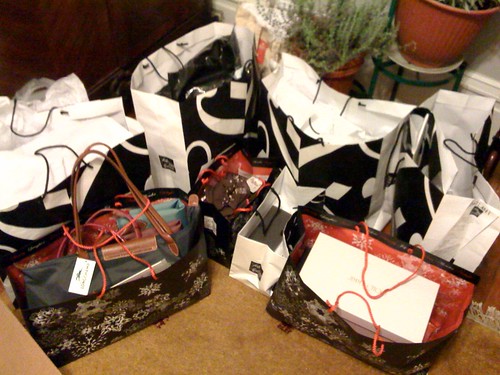
I was in Maine for the last 10 days or so (if you count the time spent driving) and as much as I enjoyed it, I am really glad to be home. I will write about the trip later on but one of the things I got to do en route was stop by the renown Woodbury Commons Premium Outlets in New York. It made a logical halfway point for a break in the drive and I was eager to visit a place I had heard about for so long. Although the store selection was overwhelming, I had limited time and was traveling with Chris and Speck, the dog. For this reason I chose the stores I wanted to visit carefully and browsed swiftly. I was able to visit Chloé, Balenciaga, Barneys, Off Fifth, Neiman Marcus Last Call, and Kate Spade. If I had unlimited time, I would have also gone into Prada, Burberry, and Tory Burch.

I was surprised by how dog friendly most of the stores were! Speck accompanied us into Barneys, Off Fifth, and Kate Spade. In Barneys they even gave her a bowl with fresh water! I didn't buy anything except for some road snacks from Off Fifth (thanks to the Mystery Money promo, they were basically free). I did see a dress I've coveted for a while in the Chloé outlet, but even the outlet discounts were too spendy for my budget.

Maine itself was kind of a clothes shopping desert, save for Portland in which cute stores abound but I didn't shop... even the outlets in Freeport where the L.L. Bean flagship store is located had nothing I wanted. I did buy plenty of food, though. Ice cream, lobster, farm fresh cheeses and produce, etc. I didn't succumb to vacation goggles OR outlet goggles. Both can skew tastes with the lure of the novel. I did buy some things at the New Hampshire Liquor and Wine Outlet. But libations are different. :)

LinkWithin

Related Posts with Thumbnails